
Chest Pain: When Should You Go to an Emergency Hospital in Ranchi?

Quick answer: Treat chest pain as an emergency when it is sudden, severe, pressure-like or accompanied by breathlessness, sweating, nausea, faintness or pain spreading to the arm, shoulder, back, neck or jaw. Call India's emergency number 112 or arrange urgent medical help. Do not drive yourself if a heart attack or another serious condition is possible.
For people looking for a chest pain emergency hospital in Ranchi, the first priority should be timely assessment, stabilisation and a clear plan based on the patient's condition — not waiting to see whether the pain settles.
Quick answer: when is chest pain an emergency?
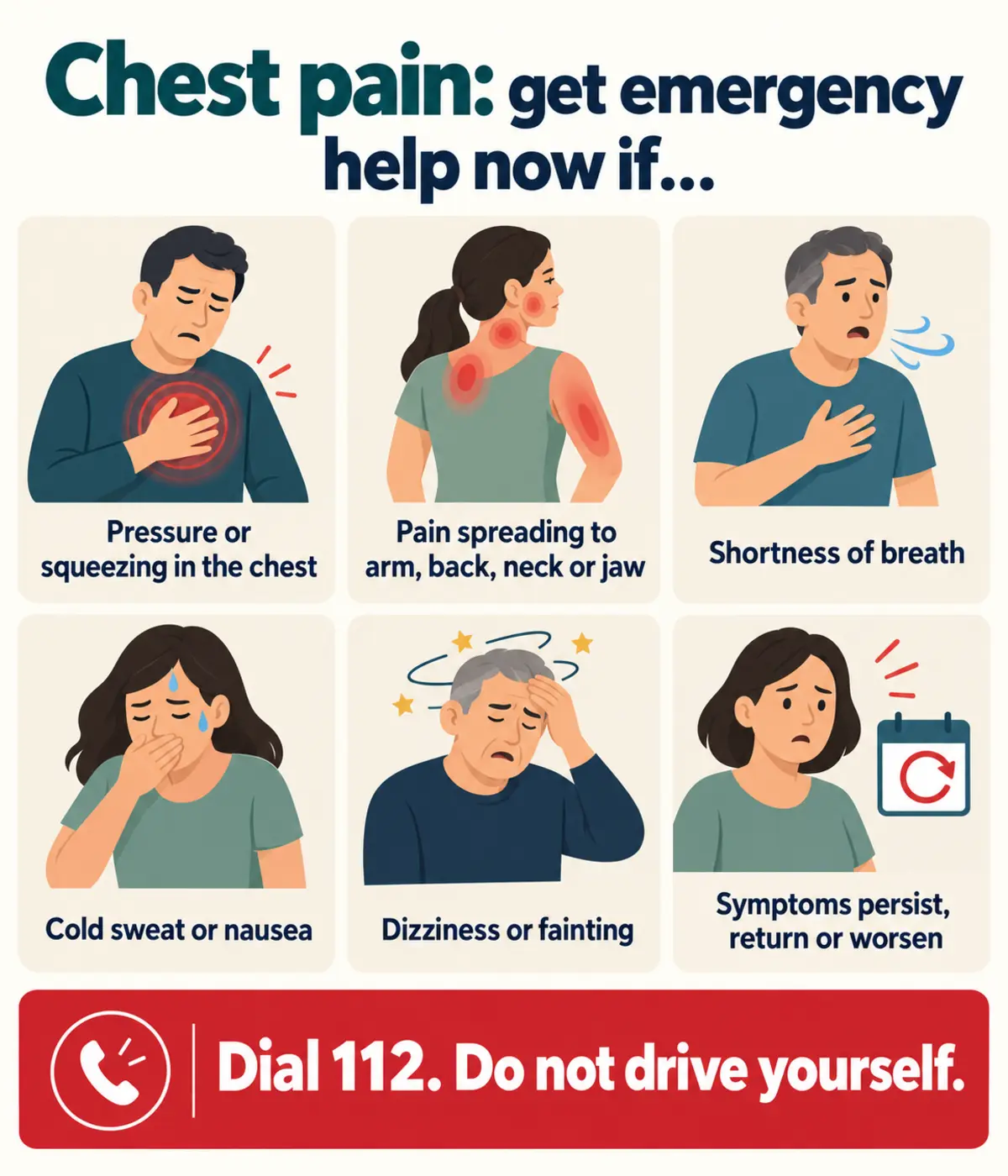
Seek emergency medical care immediately if chest discomfort:
- Feels like pressure, squeezing, heaviness, tightness or crushing pain
- Lasts more than a few minutes, returns, or is getting worse
- Spreads to one or both arms, the shoulders, back, neck, jaw or upper abdomen
- Occurs with shortness of breath, cold sweating, nausea, vomiting, dizziness or fainting
- Begins during exertion or occurs at rest in a person with heart-risk factors
- Occurs with a very fast, slow or irregular heartbeat and weakness
- Is accompanied by sudden severe breathlessness, coughing blood or bluish lips
- Follows an injury or is associated with collapse
- Feels like sudden tearing pain moving toward the back
Do not wait for every symptom to appear. Heart emergencies do not always begin with dramatic pain.
सीने में अचानक दबाव, जकड़न या दर्द के साथ सांस फूलना, पसीना, उल्टी, चक्कर या हाथ/जबड़े/पीठ में दर्द हो तो इंतजार न करें। 112 पर कॉल करें या तुरंत इमरजेंसी सहायता लें। खुद गाड़ी चलाकर अस्पताल न जाएं।
Heart-attack warning signs people often miss
Many people expect a heart attack to cause sudden, unbearable left-sided pain. In reality, the discomfort may be mild, build gradually, disappear and return, or feel like gas, acidity or indigestion.
Symptoms vary. Some people experience severe pain, while others mainly feel breathless, unusually tired, nauseated or faint.
Can women, older adults and people with diabetes have different symptoms?
Yes. Chest discomfort remains an important symptom, but women may also report breathlessness, nausea, unusual fatigue, back pain or jaw pain. Older adults and people with diabetes may have less typical or less intense pain.
This does not mean every episode of tiredness or indigestion is a heart attack. It means that new, unexplained symptoms — especially in someone with diabetes, high blood pressure, high cholesterol, smoking history, kidney disease, obesity or previous heart disease — should not be dismissed without assessment.
Is every chest pain a heart attack?
No. Chest pain can have many causes, including:
- Reduced blood flow to the heart or a heart attack
- Inflammation around the heart
- A blood clot in the lungs
- A collapsed lung, lung infection or inflammation around the lungs
- A problem affecting the body's main artery
- Acidity, reflux or spasm of the food pipe
- Strain or inflammation of chest-wall muscles and ribs
- Shingles
- Panic or anxiety
The difficulty is that serious and non-serious conditions can feel similar. Pain caused by acidity can resemble heart pain. Anxiety can occur during a heart emergency, and a person with a known anxiety disorder can still develop heart or lung disease. A safe diagnosis requires clinical assessment.
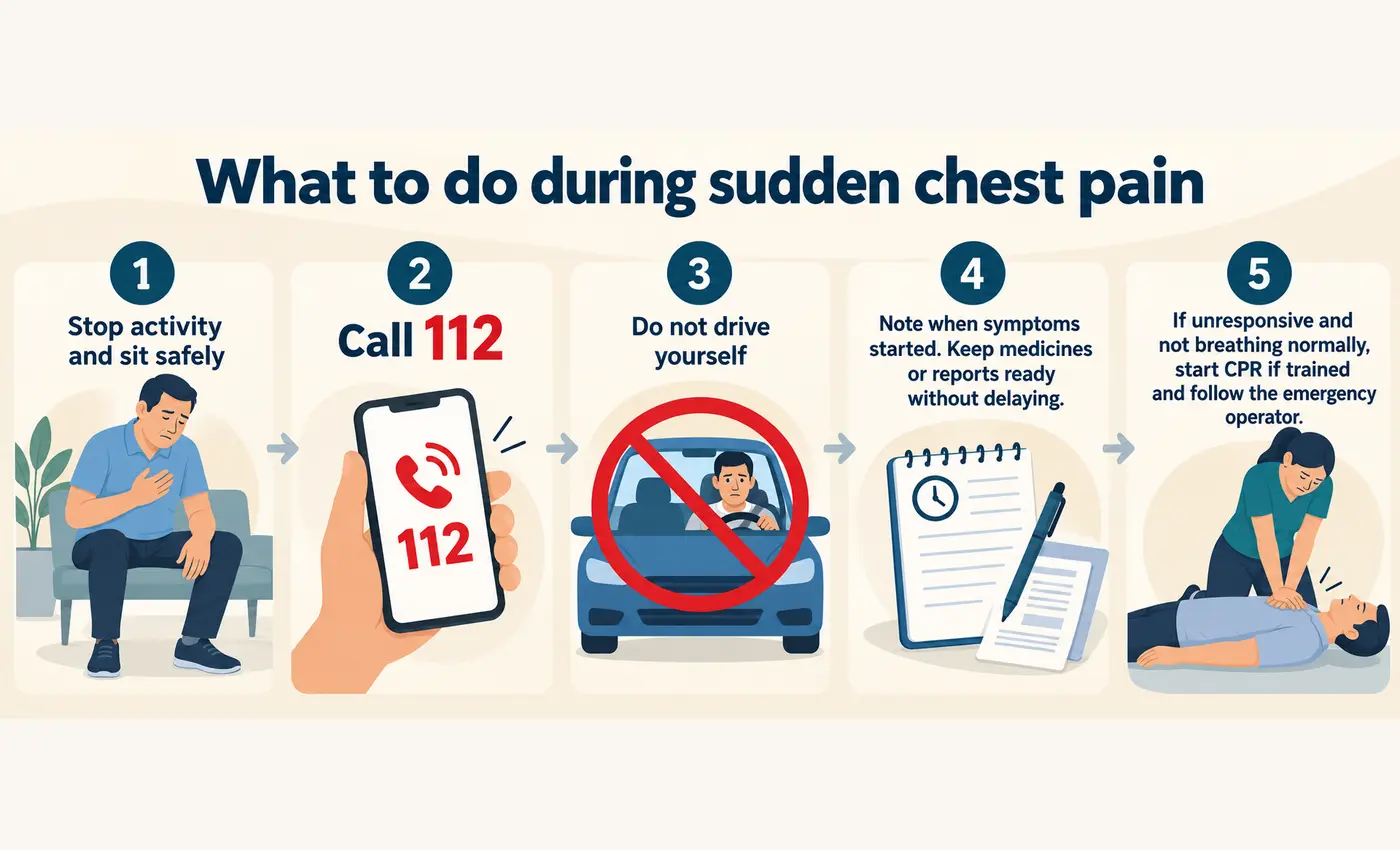
What should you do immediately during sudden chest pain?
1. Stop activity and sit safely
Ask the person to stop walking, climbing stairs or working. Let them sit in a comfortable position and remain with them.
2. Call for emergency help
For severe symptoms, collapse or suspected heart attack, dial 112, India's integrated emergency number, or call an appropriate ambulance service. Give the exact location, symptoms and time of onset.
3. Do not let the patient drive
Symptoms can worsen suddenly. An ambulance or another responsible adult is safer than the patient driving alone.
4. Keep useful information ready
Note when the symptoms began. Carry the patient's medicine list, allergy information, identity documents and relevant previous reports if these are immediately available. Do not delay departure to search for paperwork.
5. If the person becomes unresponsive
If the person is unresponsive and not breathing normally, call 112, begin CPR if trained and use an automated external defibrillator if one is available. Follow the emergency operator's instructions.
What should you not do?
- Do not wait for the pain to become unbearable
- Do not assume the pain is only gas, acidity or stress
- Do not keep walking to “test” whether the pain gets worse
- Do not drive yourself when serious symptoms are present
- Do not take someone else's heart medicine
- Do not take food, alcohol or an unprescribed remedy and wait for relief
- Do not delay medical care because the first episode settled
Medication during suspected heart trouble must be guided by a qualified clinician or emergency professional because the correct treatment depends on the diagnosis, allergies, bleeding risk, blood pressure and medicines already being taken.
What happens during emergency assessment for chest pain?
The emergency team first looks for immediate threats to breathing, circulation and consciousness. Assessment may include:
- Rapid triage and a focused history
- Pulse, blood pressure, breathing rate, temperature and oxygen-saturation checks
- Physical examination
- An electrocardiogram, commonly called an ECG
- Blood tests, which may include a cardiac marker such as troponin
- Repeat ECGs or blood tests when clinically required
- Chest X-ray or other imaging for selected patients
- Monitoring, observation, admission, ICU care or transfer depending on the findings
Not every patient needs every test. The choice and timing depend on symptoms, examination, risk factors and the suspected cause.
Can one normal ECG rule out a heart attack?
Not always. An initial ECG can be normal or non-diagnostic in some patients. Doctors interpret it together with symptoms, examination, blood tests and changes over time. If clinical concern remains, repeat testing or observation may be necessary.
When may ICU care be required?
Some patients with chest pain are stable and can be evaluated without ICU admission. ICU or critical-care monitoring may be considered when there is:
- Unstable blood pressure or circulation
- Significant breathing difficulty or low oxygen level
- An abnormal heart rhythm requiring close monitoring
- Reduced consciousness or repeated collapse
- Continuing or recurrent symptoms with high-risk findings
- Need for intensive observation or organ support
- Another serious illness identified during assessment
The decision is based on the patient's condition, not on the word “chest pain” alone.
What if the patient needs treatment not available at the first hospital?
The first hospital still has an important role. Emergency teams can assess the patient, begin clinically appropriate stabilisation, monitor deterioration and determine the next level of care.
If a required procedure, specialist or facility is not available onsite, the treating team may recommend referral or transfer to an appropriate higher centre. The urgency, destination and transfer method should be decided by the treating clinicians according to the diagnosis and the patient's stability.
Families should not shift an unstable patient in a private vehicle without medical advice.
Chest-pain emergency and ICU care at Hopewell Hospital, Ranchi
Hopewell Hospital provides 24×7 Emergency Medicine in Ranchi. Its current chest-pain pathway is focused on:
- Initial emergency assessment and triage
- Clinically appropriate stabilisation
- Vital-sign and critical-care monitoring
- Diagnostic support as advised by the treating team
- ICU care when clinically indicated
- Referral or transfer when a patient needs a specialist service or procedure not available onsite
This description is deliberately limited to Hopewell's current operational scope. It should not be interpreted as a claim that every cardiac investigation or intervention is available at the hospital.
For active or severe chest pain, do not use a routine appointment form and wait for a reply. Call 112 or seek immediate emergency assistance. Contact Hopewell Hospital or get directions for non-emergency planning.
Hopewell Hospital is located at New Hopewell Hospital, Hazari Baug Road, Tharpakna, Ranchi, Jharkhand 834001.
How should you choose an emergency hospital for chest pain in Ranchi?
In a time-sensitive emergency, proximity and the ability to assess and stabilise the patient matter. Useful questions include:
- Is emergency care available at that time?
- Can the team perform prompt triage and clinical assessment?
- Is ECG and relevant diagnostic support available or arrangeable?
- Can the patient be monitored and admitted to an ICU if needed?
- Is there a defined escalation and transfer pathway if advanced care is required elsewhere?
- Will the family receive clear communication about the working diagnosis and next step?
Do not choose solely on an advertisement that uses words such as “advanced,” “complete” or “best.” Match the hospital's verified capabilities to the patient's immediate need.
Can recurring mild chest pain wait for a clinic appointment?
Recurring discomfort during walking, climbing stairs or emotional stress may represent angina and needs medical evaluation even if it settles with rest. New, worsening or rest pain should be treated more urgently.
For non-emergency follow-up and risk-factor management, Hopewell provides Diabetes & Hypertension Care and Preventive Health Check-ups. These services are not substitutes for emergency assessment during active warning symptoms.
Final answer: when should you go to an emergency hospital for chest pain?
Treat chest pain as an emergency when it is sudden, severe, pressure-like or spreading, or when it occurs with breathlessness, sweating, nausea, faintness or an irregular heartbeat. Call 112 or seek immediate emergency assistance rather than waiting to see whether it settles, and do not drive yourself when a serious cause is possible.
Have questions about this condition?
Speak with the Hopewell Hospital team for a personalised assessment and treatment plan.
Frequently asked questions
How long should I wait before seeking help for chest pain?
Do not use a fixed waiting period when chest pain is new, severe, pressure-like, recurrent or accompanied by breathlessness, sweating, nausea, faintness or spreading pain. Call 112 or seek emergency care immediately.
Can gas or acidity feel like heart pain?
Yes. Reflux and other digestive problems can cause burning or pressure, but heart pain can also feel like indigestion. New or unexplained symptoms should not be self-diagnosed, particularly in someone with heart-risk factors.
Can a heart attack happen without severe chest pain?
Yes. Symptoms may be mild, intermittent or dominated by breathlessness, nausea, sweating, fatigue, jaw pain, back pain or light-headedness.
Is left-sided chest pain always from the heart?
No. The location alone cannot confirm or exclude a heart problem. Heart-related discomfort may occur in the centre, left side or beyond the chest.
Should I drive myself to hospital?
No, not when a serious cause is possible. Call 112 or arrange emergency transport. Symptoms can worsen or lead to collapse while driving.
Can stress or anxiety cause chest pain?
Yes, but anxiety should not be assumed until dangerous causes have been considered. A person with anxiety can also have heart or lung disease.
What tests may be done for chest pain?
Depending on the situation, clinicians may use an ECG, blood tests such as troponin, chest X-ray and selected additional imaging or monitoring. Not every patient needs every test.
Does a normal ECG mean there is no heart problem?
Not always. Doctors interpret the ECG together with symptoms, examination and blood tests. Repeat assessment may be required when concern remains.
Does Hopewell Hospital provide emergency and ICU care for chest-pain patients?
Hopewell provides 24×7 emergency and critical care, initial assessment, stabilisation, monitoring and ICU care when clinically indicated. If a patient needs a service or procedure not available onsite, the treating team may advise or coordinate transfer to an appropriate higher centre.
What number should I call during a medical emergency in Ranchi?
Dial 112, India's integrated emergency number. Hopewell Hospital can also be contacted directly, but a person with severe symptoms should not delay emergency assistance while waiting for a routine response.
Medical disclaimer
This article is for general education and cannot diagnose chest pain or replace urgent medical assessment. If you or another person currently has chest pain with any warning symptom described above, call 112 or seek emergency help now.