
Kidney Stones: When Is Surgery Needed and When Can They Pass Naturally?

Quick answer: Kidney-stone pain can begin suddenly and become severe within minutes. Some stones pass in the urine with appropriate medical guidance, while others block urine flow, cause infection, continue to produce pain or require a procedure. The correct decision depends on the stone's size and location, the degree of blockage, symptoms, infection, kidney function and the patient's overall health.
If you are looking for kidney stone treatment in Ranchi, do not decide from the stone size alone. A urologist should review the symptoms, examination, urine and blood tests, and appropriate imaging before recommending observation, medicine, drainage or stone removal.
Quick answer: when may a kidney stone need a procedure?
A kidney-stone procedure may be considered when:
- The stone is causing blockage with fever or urinary infection
- Pain remains severe or keeps returning despite appropriate treatment
- Vomiting or dehydration prevents safe care at home
- Urine output is very low or has stopped
- Kidney function is worsening
- The patient has one functioning kidney or obstruction affecting both kidneys
- The stone is unlikely to pass or has not progressed during follow-up
- Persistent obstruction may harm the kidney
- Observation is unsuitable because of the patient's clinical condition, occupation, travel needs or informed preference
An infected, obstructed urinary system is an emergency. The first urgent procedure may be drainage of urine rather than definitive removal of the stone. Stone treatment is usually planned after infection and the patient's condition have been controlled.
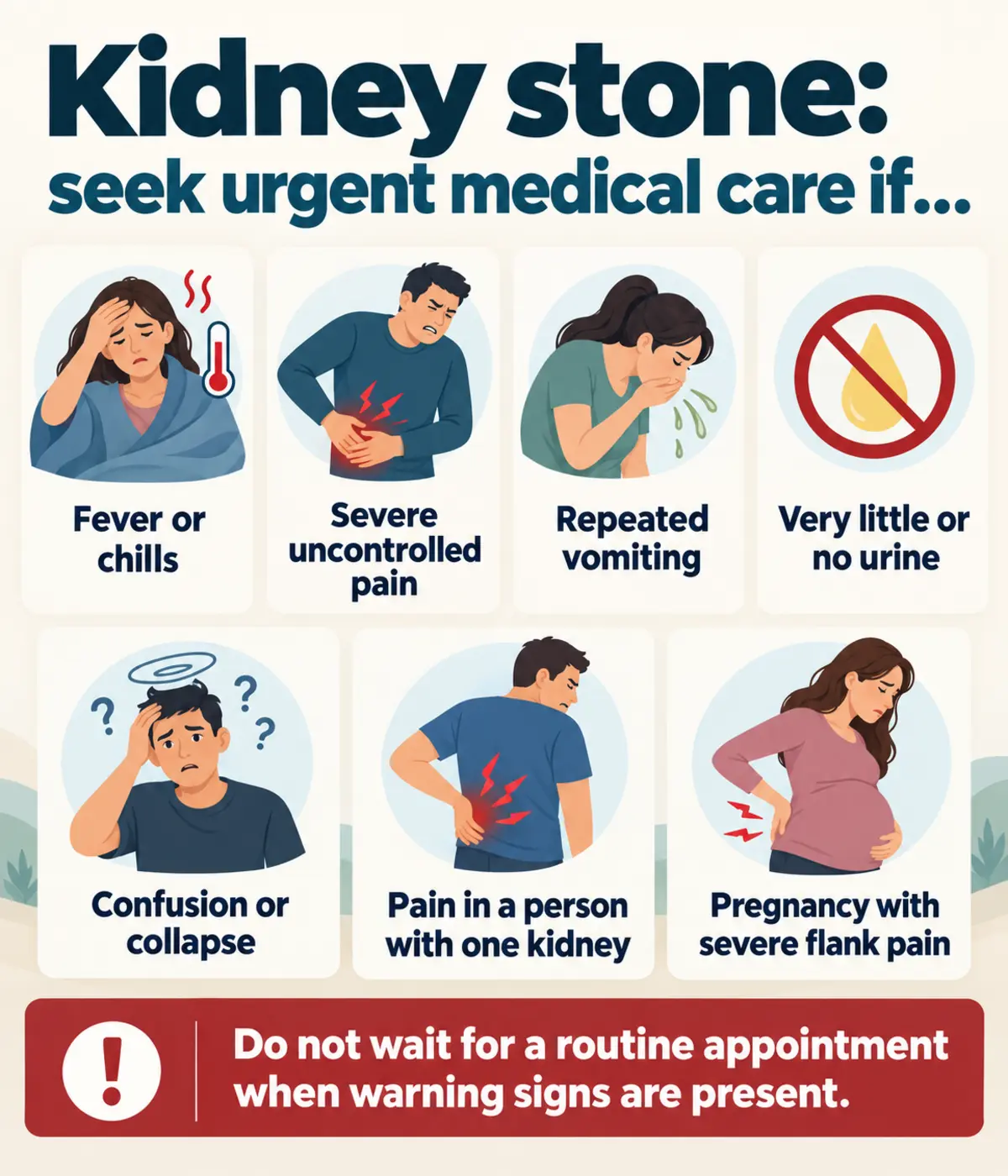
Kidney-stone warning signs that need urgent medical care
Seek urgent assessment if suspected kidney-stone pain occurs with any of the following:
Do not wait for every symptom to appear. Severe flank pain, visible blood in the urine, fever, persistent vomiting or reduced urine output should not be self-diagnosed at home.
What is a kidney stone?
A kidney stone is a hard deposit formed from minerals and salts in the urine. Stones may remain inside the kidney without symptoms or move into the ureter, the narrow tube carrying urine from the kidney to the bladder. When a stone obstructs the ureter, it can cause renal colic: intense pain that often comes in waves.
Kidney stones vary in composition. Common types include calcium-based stones, uric-acid stones, infection-related stones and cystine stones. The stone type can influence prevention, but symptoms and immediate treatment are determined mainly by obstruction, infection, pain, kidney function and the stone's position.
What do kidney-stone symptoms feel like?
Symptoms may include:
- Sharp pain in the back or side below the ribs
- Pain moving towards the lower abdomen or groin
- Pain that comes in waves and changes in intensity
- Nausea or vomiting
- Blood in the urine
- Burning or pain while passing urine
- Frequent or urgent urination
- Cloudy or foul-smelling urine
- Difficulty passing urine
These symptoms are not unique to stones. Appendicitis, gallbladder disease, urinary infection, ovarian conditions, muscle pain and other abdominal problems can feel similar. A clinical assessment is important before assuming the cause.
Can a kidney stone pass naturally?
Yes, selected stones can pass without an operation. The chance depends on several factors:
- Stone size
- Location in the kidney or ureter
- Shape and anatomy of the urinary tract
- Whether urine flow is blocked
- The degree and duration of symptoms
- Infection, swelling and kidney function
- Previous stone history
- Whether pain and oral fluids can be managed safely
Smaller stones located farther down the ureter are generally more likely to pass than larger stones higher in the urinary tract. However, no single size guarantees passage or automatically proves that surgery is required. Imaging findings must be interpreted with the patient's condition.
Observation should be an active plan, not simply “waiting.” It may include prescribed pain relief, medicines for nausea, selected medical expulsive therapy, hydration guidance, instructions to strain the urine, and a defined follow-up plan with repeat assessment or imaging.
What tests may be needed for kidney stones?
Clinical assessment
The clinician asks where the pain began, whether it moves, when it started, whether there is fever or vomiting, urinary symptoms, previous stones, kidney disease, pregnancy possibility, medicines and other medical conditions.
Urine tests
Urinalysis can identify blood, signs of infection and other abnormalities. A urine culture may be required when infection is suspected. Blood in the urine can occur with stones, but its absence does not completely exclude a stone.
Blood tests
Tests may assess kidney function, infection, hydration and relevant mineral levels. The exact panel depends on the clinical situation.
Imaging
Imaging identifies whether a stone is present, its size and location, and whether it is causing obstruction. Ultrasound avoids radiation and is commonly used in selected patients, particularly during pregnancy and in children. A non-contrast CT scan can provide detailed information, but it is not automatically necessary for every patient. The clinician should select imaging according to age, symptoms, pregnancy status, previous imaging and urgency. Patients should bring earlier scans and reports where available, but urgent care should not be delayed to search for documents.
Does the size alone decide whether surgery is needed?
No. Stone size is important, but it is only one part of the decision. A relatively small stone can become urgent if it causes infection, persistent obstruction, uncontrolled pain or kidney impairment. A larger non-obstructing stone may sometimes be assessed electively depending on its location, symptoms, growth and patient factors.
A urologist also considers:
- Kidney versus ureteric location
- Hydronephrosis or swelling of the kidney
- Infection or sepsis risk
- Pain, vomiting and ability to drink
- Kidney function
- One kidney or stones on both sides
- Previous surgery or altered urinary anatomy
- Blood-thinning medicines and anaesthesia risk
- The patient's priorities after informed discussion
When is kidney-stone treatment an emergency?
The most important emergency is obstruction combined with infection. Bacteria can multiply in urine trapped above the blockage and enter the bloodstream. Antibiotics are important, but an obstructed infected kidney may also need urgent drainage.
Emergency drainage may be achieved with a ureteric stent placed internally or a nephrostomy tube placed through the skin into the kidney. These procedures relieve pressure and allow infected urine to drain. They are not always the final stone-removal treatment.
Definitive stone treatment is commonly delayed until infection has been treated and the patient is stable. A person who is unwell with fever, chills, confusion, low blood pressure or breathing difficulty may require close monitoring or ICU care.
What treatments are available for kidney stones?
Treatment is personalised. The options below are general educational information and do not confirm that every procedure is available at Hopewell Hospital.
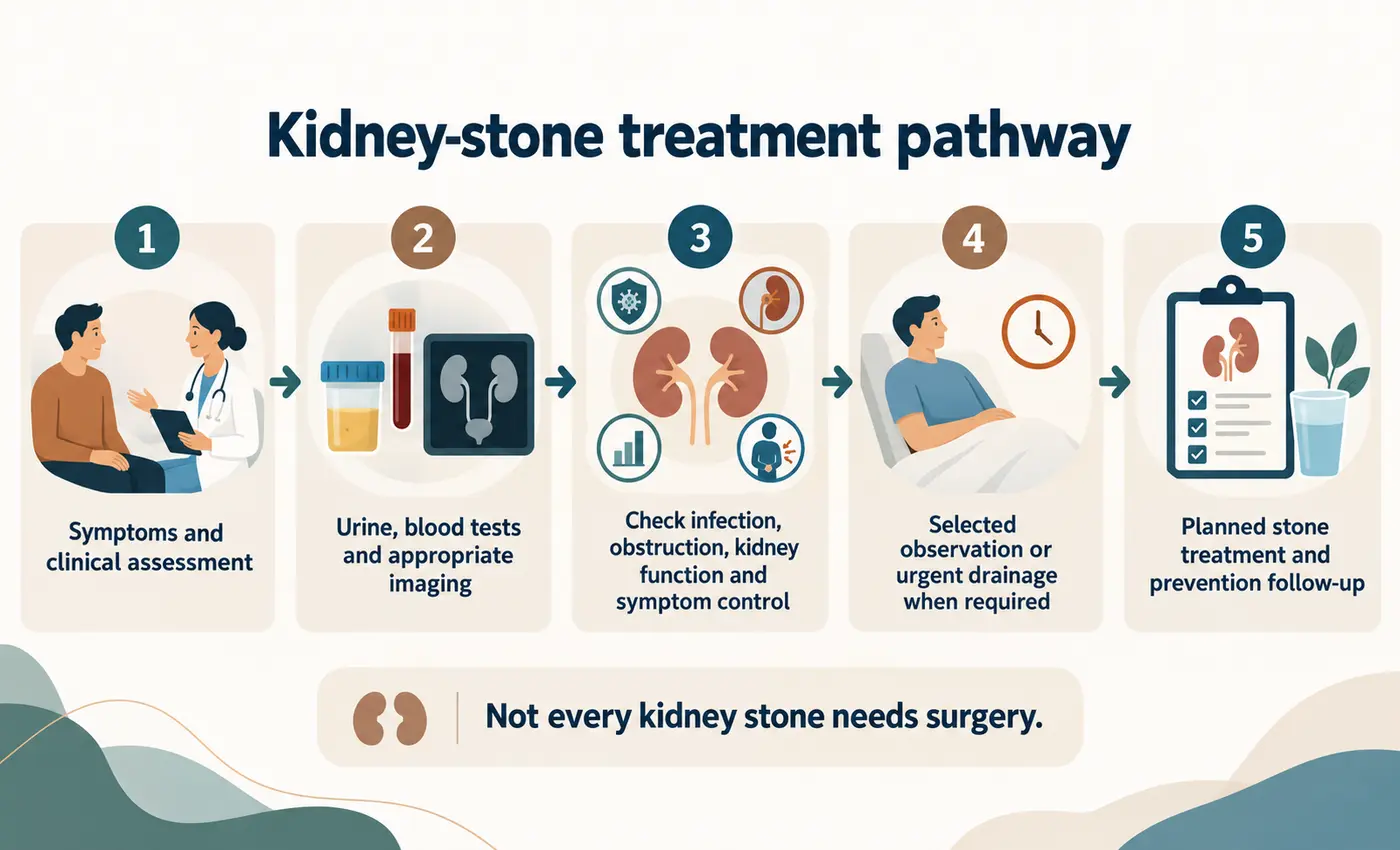
The “least invasive” option is not automatically the best option for every stone. The aim is a safe, effective plan suited to the patient and the stone.
What is laser kidney-stone surgery?
“Laser kidney-stone surgery” commonly refers to ureteroscopy in which a thin endoscope is passed through the urethra and bladder into the ureter or kidney. A laser may fragment the stone, and pieces may be removed or allowed to pass.
There is no skin incision for routine ureteroscopy, but it still involves anaesthesia, instrumentation and possible temporary stent placement. Risks can include infection, bleeding, ureteric injury, residual fragments, need for another procedure and stent-related discomfort. The treating urologist should explain alternatives and the expected plan for the individual patient.
Do not advertise “laser” as automatically painless, risk-free, incision-free in every case or guaranteed to clear all stones in one sitting.
What is a ureteric stent, and why may it be needed?
A ureteric stent is a thin flexible tube placed between the kidney and bladder to help urine drain. It may be used to relieve obstruction, support healing after a procedure or protect drainage while swelling settles.
A stent can cause urinary frequency, urgency, burning, blood in the urine or discomfort in the bladder, side or groin. Patients should receive clear instructions about the removal or change date. A forgotten stent can become encrusted and cause serious complications.
Seek advice if stent symptoms are severe or occur with fever, inability to pass urine, persistent vomiting or worsening illness.
Can home remedies dissolve kidney stones?
Most stones cannot be safely diagnosed or dissolved with a home remedy. Some uric-acid stones may be dissolved through medically supervised urine alkalinisation, but this requires correct diagnosis, prescribed treatment and monitoring. Calcium stones do not simply dissolve with lemon water, herbal products or “stone-removal” mixtures.
Do not delay urgent assessment while trying a remedy. Unregulated products may interact with medicines, affect the liver or kidneys, or give false reassurance while obstruction continues.
During acute severe pain, do not force excessive water in the hope of pushing out a blocked stone. Follow the clinician's hydration advice, especially if vomiting, kidney impairment, heart disease or another fluid restriction is present.
How can recurrent kidney stones be prevented?
Prevention should be based on the stone type and the patient's risk factors. After the acute episode, the clinician may advise stone analysis, blood tests and, for selected recurrent or high-risk patients, a 24-hour urine assessment.
General measures may include:
- Drinking enough fluid to maintain an appropriate urine output, unless medically restricted
- Reducing excess salt intake
- Maintaining normal dietary calcium rather than eliminating calcium without advice
- Avoiding excessive intake of animal protein where clinically relevant
- Adjusting oxalate, purine or other dietary factors according to stone type
- Achieving a healthy weight gradually
- Treating recurrent urinary infection or metabolic conditions
- Taking preventive medicine when prescribed
A universal “kidney-stone diet” can be misleading. The prevention plan for calcium oxalate, uric-acid, infection and cystine stones is not identical.
Choosing a kidney-stone doctor or hospital in Ranchi
People often search for the “best urologist in Ranchi” or “best kidney-stone hospital in Jharkhand,” but a safe choice should be based on verifiable factors rather than rankings or advertisements. Useful questions include:
- Is a qualified urologist available to assess the patient?
- Can urine tests, kidney-function tests and appropriate imaging be arranged?
- Is emergency assessment available for fever, severe pain, vomiting or reduced urine output?
- Which stone procedures are genuinely operational at the hospital?
- Is anaesthesia, inpatient monitoring and critical-care support available when required?
- How will infection and obstruction be managed?
- What happens if a required procedure or specialist service is not available onsite?
- Will the patient receive written instructions for medicines, follow-up and stent removal?
- Can the hospital provide a clear, itemised estimate after clinical evaluation?
Do not choose only on a promise such as “100% stone clearance,” “painless treatment,” “no risk” or a fixed package advertised before assessment.
Kidney-stone evaluation at Hopewell Hospital, Ranchi
Hopewell Hospital can be contacted for clinical assessment and guidance for kidney-stone symptoms, led by Dr. Arvind Kumar Bhagat in Urology. Depending on the treating clinician's advice, evaluation may include examination, urine and blood tests, imaging and a treatment plan. Emergency assessment, monitoring and ICU care may be used when clinically indicated.
If a required procedure, specialist or facility is not available onsite, the treating team may advise or coordinate referral or transfer according to the patient's condition.
To discuss kidney-stone symptoms, view Hopewell's doctors, book an appointment or contact Hopewell Hospital. If severe pain occurs with fever, chills, repeated vomiting, confusion, reduced urine output or collapse, seek urgent medical care rather than waiting for a routine online response.
Hopewell Hospital is located at New Hopewell Hospital, Hazari Baug Road, Tharpakna, Ranchi, Jharkhand 834001.
Final answer: when do kidney stones need surgery?
Some kidney stones pass naturally with appropriate observation and medical care, while others need a procedure because of infection, persistent obstruction, uncontrolled pain or worsening kidney function. Stone size alone does not decide treatment — a urologist should combine symptoms, examination, imaging and kidney function before recommending observation, medicine, drainage or stone removal.
Have questions about this condition?
Speak with the Hopewell Hospital team for a personalised assessment and treatment plan.
Frequently asked questions
Can every kidney stone pass naturally?
No. Some stones pass with appropriate observation and medical care, while others remain stuck, cause obstruction, produce infection or require a procedure. Size, location, symptoms, kidney function and imaging findings guide the decision.
What size kidney stone needs surgery?
There is no single size that decides treatment for every person. Larger stones are generally less likely to pass, but a smaller stone may also need urgent treatment if it causes infection, persistent obstruction, uncontrolled pain or kidney impairment.
Is kidney-stone pain always felt in the back?
No. Pain may begin in the side or back and move towards the abdomen, groin or genital area. Symptoms can overlap with other abdominal, urinary or gynaecological conditions.
Can kidney stones cause fever?
A stone itself does not usually explain fever safely. Fever or chills with suspected obstruction may indicate infection and requires urgent medical assessment.
Is blood in the urine normal with a kidney stone?
Blood can occur when a stone irritates the urinary tract, but visible blood should be assessed because infection, tumours and other urinary conditions can also cause it.
Is CT scan necessary for every kidney stone?
No. CT provides detailed information but is selected according to the clinical situation. Ultrasound or other imaging may be more appropriate in some patients, including pregnancy and childhood.
Can medicines dissolve kidney stones?
Most stones do not dissolve with medicine. Selected uric-acid stones may respond to medically supervised urine alkalinisation. Medicines may also be used for pain, nausea, infection or to help selected ureteric stones pass.
Will I always need a stent after stone surgery?
No. Stent use depends on the procedure, swelling, infection, ureteric condition and the urologist's judgement. If placed, the patient should know when and how it will be removed.
Can kidney stones return after treatment?
Yes. Recurrence is possible. Stone analysis, adequate fluid intake, dietary changes and selected metabolic evaluation or medicines can reduce risk, but prevention should be personalised.
Where can I seek kidney-stone evaluation in Ranchi?
Patients can contact Hopewell Hospital through the appointment page. For severe symptoms, use urgent medical services rather than waiting for a routine appointment.
Medical disclaimer
This article is for general education and does not diagnose kidney stones or replace examination by a qualified clinician. Severe pain, fever, chills, persistent vomiting, reduced urine output, confusion or collapse requires urgent medical assessment.